
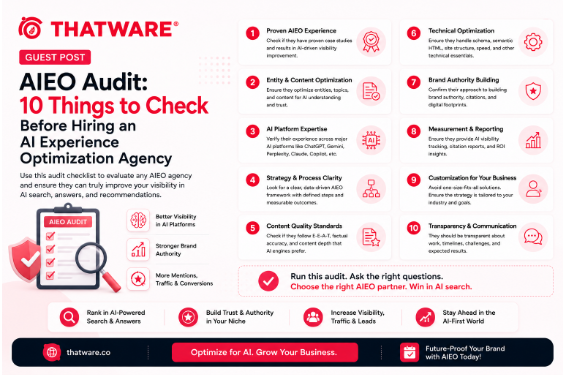
Before you sign a contract with an AIEO agency, you should have a reasonably clear picture of where you currently stand. Not because you need to do the work yourself — that’s what you’re hiring an agency to help with — but because understanding your baseline makes the agency selection process more informed, makes scope-of-work negotiations more grounded, and helps you evaluate whether the proposals you’re getting are calibrated to your actual situation.
A proper AIEO audit isn’t a one-afternoon exercise. But there’s a lighter version — a diagnostic checklist — that any business can run through without specialized tools or deep technical expertise. Here are the ten things worth checking before that first agency conversation.
1. Test Your Current AI Visibility
Start with the most direct diagnostic. Open ChatGPT, Gemini, and Perplexity and ask them about your brand, your products, and your market category. A few specific queries:
Ask each system “what is [your brand name]” and see how confidently and accurately it responds. Ask “what are the best [your category] providers” and see whether your brand appears. Ask about a specific topic where your brand has strong expertise and see whether you’re cited.
Document what you find. Is the information accurate? Is it current? Is your brand mentioned at all in category queries? The gap between where you are and where you should be is a rough proxy for your AIEO investment needs.
2. Audit Your Entity Presence
Check whether your brand has a Google Knowledge Panel. Search for your brand name on Google — does a panel appear on the right side with structured information about your company? A Knowledge Panel suggests reasonable entity recognition. Its absence (for brands of meaningful size) is a signal worth addressing.
Check your structured data at schema.org levels. Use Google’s Rich Results Test to review what structured data your site is currently emitting. Is the Organization schema present and complete? Are Product, Person, and other relevant schema types implemented where they should be?
Check Wikidata — does your organization exist as a Wikidata entity? This is a concrete data point that feeds into AI knowledge systems in ways that matter.
3. Evaluate NAP Consistency
AIEO audit services almost always include a NAP (Name, Address, Phone) consistency check. Run your brand name, primary address, and phone number through the major directory platforms — Google Business Profile, Bing Places, Yelp, Apple Maps, Foursquare, Trustpilot, and industry-specific directories relevant to your category.
Identify any inconsistencies — different phone number formats, abbreviated vs. spelled-out address variations, different business name presentations. List them. Resolving them is foundational AIEO work, and it’s useful to know the scope before agency conversations.
4. Assess Content Depth on Priority Topics
Pick your three most important topic areas — the spaces where your brand has the strongest expertise claims and where AI citations would be most valuable commercially. For each, honestly evaluate: does your existing content go deep enough to be genuinely reference-worthy?
Depth markers to check: does the content answer not just the obvious question but the follow-up questions? Does it cite credible sources? Is it authored by someone with identifiable credentials? Has it been updated recently? Does it cover edge cases and nuances, or just the headline information?
If the honest answer is “our content on this topic is solid but not outstanding,” that’s a common finding — and it points toward content deepening as a near-term AIEO priority.
5. Check Your Backlink Profile Through an AIEO Lens
Traditional backlink audits look at domain authority and anchor text. An AIEO-oriented backlink review asks different questions: which authoritative publications have cited you? Are you referenced by sources that AI systems have been trained to consider credible — major industry publications, academic or research institutions, established news organizations?
Look at the quality distribution of your citation sources, not just the volume. Ten citations from Tier 1 industry publications are more valuable for AIEO purposes than hundreds from low-authority directories.
6. Review Your Review Ecosystem
Check your review volume and sentiment on major platforms relevant to your category — Google Reviews, G2, Capterra, Trustpilot, Tripadvisor, or industry-specific equivalents. Note: total review count, average rating, recency of reviews, and how actively you’re responding.
AI systems use review data as a quality signal. A business with 50 detailed reviews averaging 4.5 stars, with thoughtful business responses, presents a very different AI authority profile than one with 8 reviews from three years ago.
7. Assess Your Multi-Platform Content Footprint
AI systems draw on information from diverse source types — not just your website. Audit how your brand appears in: LinkedIn (company page completeness, executive profiles), YouTube (if applicable — video content from credible brands contributes to AI training data), podcast appearances and transcripts, press mentions across the past 12-24 months, and any forum or community presence.
Gaps in multi-platform presence are worth noting. AI systems that can only find information about your brand from your own website have a much thinner evidence base than those that encounter you across many credible, diverse sources.
8. Test Your Content’s AI-Parseability
Take a few of your key content pages and test them informally. Paste the content into an AI assistant and ask it to summarize the key points, identify the main claims, and describe what the author’s expertise appears to be. Does the AI’s summary accurately represent what you intended the content to communicate?
AIEO pricing / AIEO packages conversations go better when you’ve done this exercise — it gives you concrete evidence of where your content is AI-parseable and where it’s not, which informs scope and priority.
9. Benchmark Against Key Competitors
Run the AI visibility tests from point one for your two or three closest competitors. Where are they appearing that you’re not? How accurately and confidently do AI systems describe them? What topics are they being cited on that you should also own?
This competitive baseline is useful for two reasons: it gives you a sense of how much AI visibility work your category competitors have already done, and it identifies specific gaps in your AI visibility that are clearly winnable given your expertise and resources.
10. Document Current Measurement Capabilities
Finally, take stock of what measurement infrastructure you currently have. What tools do you have access to? Are any of them already tracking AI-related signals — branded search trends, direct traffic patterns, referral sources? Do you have any form of AI mention monitoring in place?
Understanding your current measurement baseline helps set realistic expectations with a prospective agency about what you’ll be able to track and demonstrate as the AIEO program progresses.
Taking Your Audit Findings to Agency Conversations
Going into agency conversations with a documented diagnostic picture changes the quality of the discussion significantly. Instead of starting from zero, you can ask specific questions: “Our entity recognition appears weak — how would you approach this specifically?” “We have content depth gaps on these three topics — what’s your content deepening process?”
Agencies that can engage specifically with your diagnostic findings are demonstrating real methodology. Those that respond with generic presentations regardless of your specific situation are selling a product, not solving your problem.
The AIEO framework behind genuine AI visibility work is grounded in exactly this kind of diagnostic, specific, evidence-based approach. Knowing your baseline before the conversation starts ensures you find the right partner for where you actually are.
